Intel RealSense · computer vision
BlinkPose.Track turns an Intel RealSense depth camera into a live tracking hub — ArUco markers, full-body pose down to the feet, both hands finger by finger, faces and circular markers, detected in a single pass and each pinned to a real-world 3D position. No suit, no gloves, no markers on the person. It streams straight to a browser dashboard, with a live video feed and an in-browser 3D view of everything it sees.
6 entry types · MJPEG video · in-browser 3D · real-time
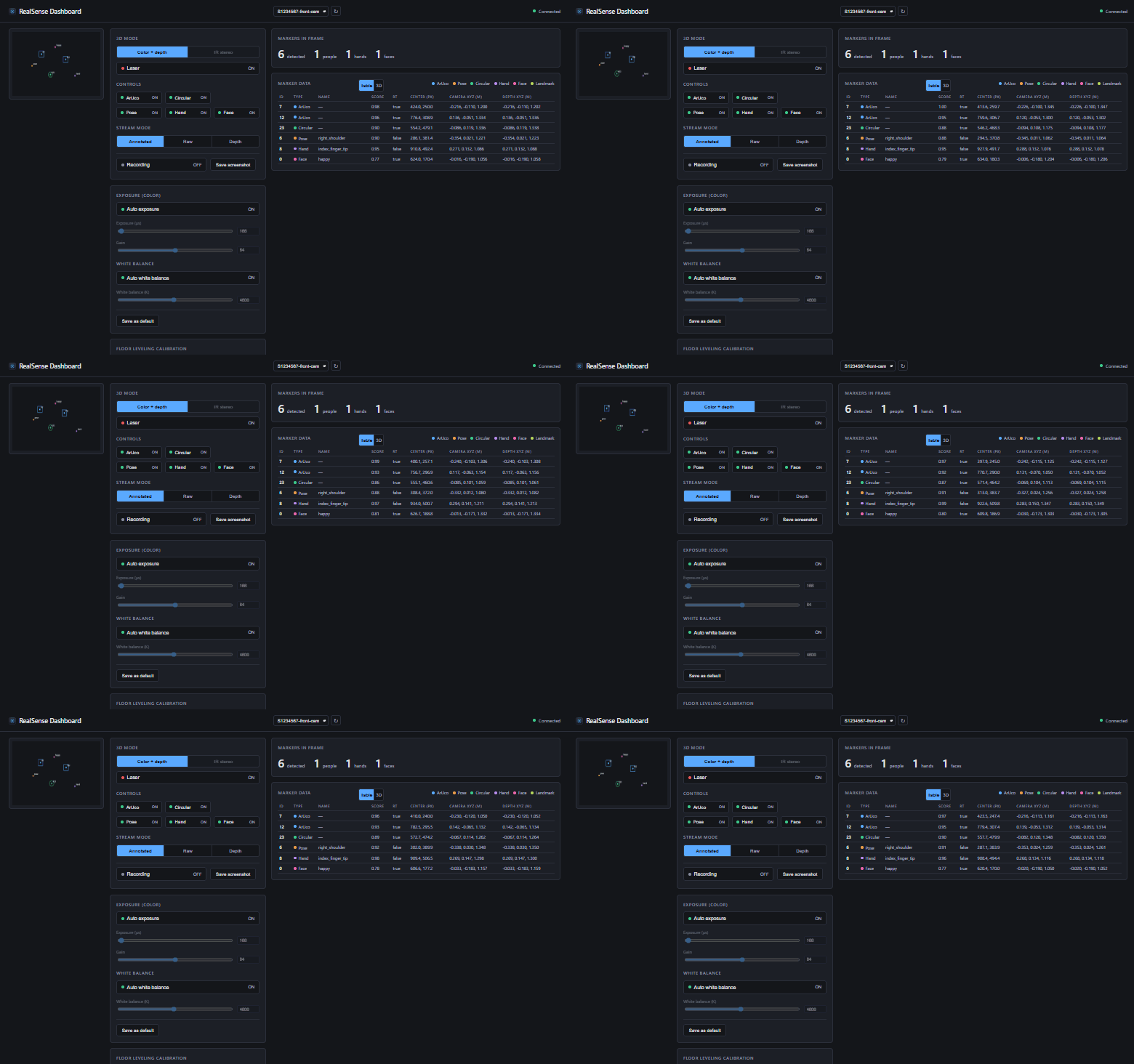
Track dashboard — live camera feed, the detection table and the in-browser 3D view, all served from the module’s own process.
What it detects
Every detection runs on the same frame and lands in one live list — mix and match whatever your setup needs.
Fiducial tags with a stable ID and a full 6-DOF pose — the workhorse for rigid objects and tools.
A full-body skeleton of 26 points per person — heels and toes included — each with its own confidence. A joint whose depth cannot be trusted is sent without a 3D position rather than with a wrong one.
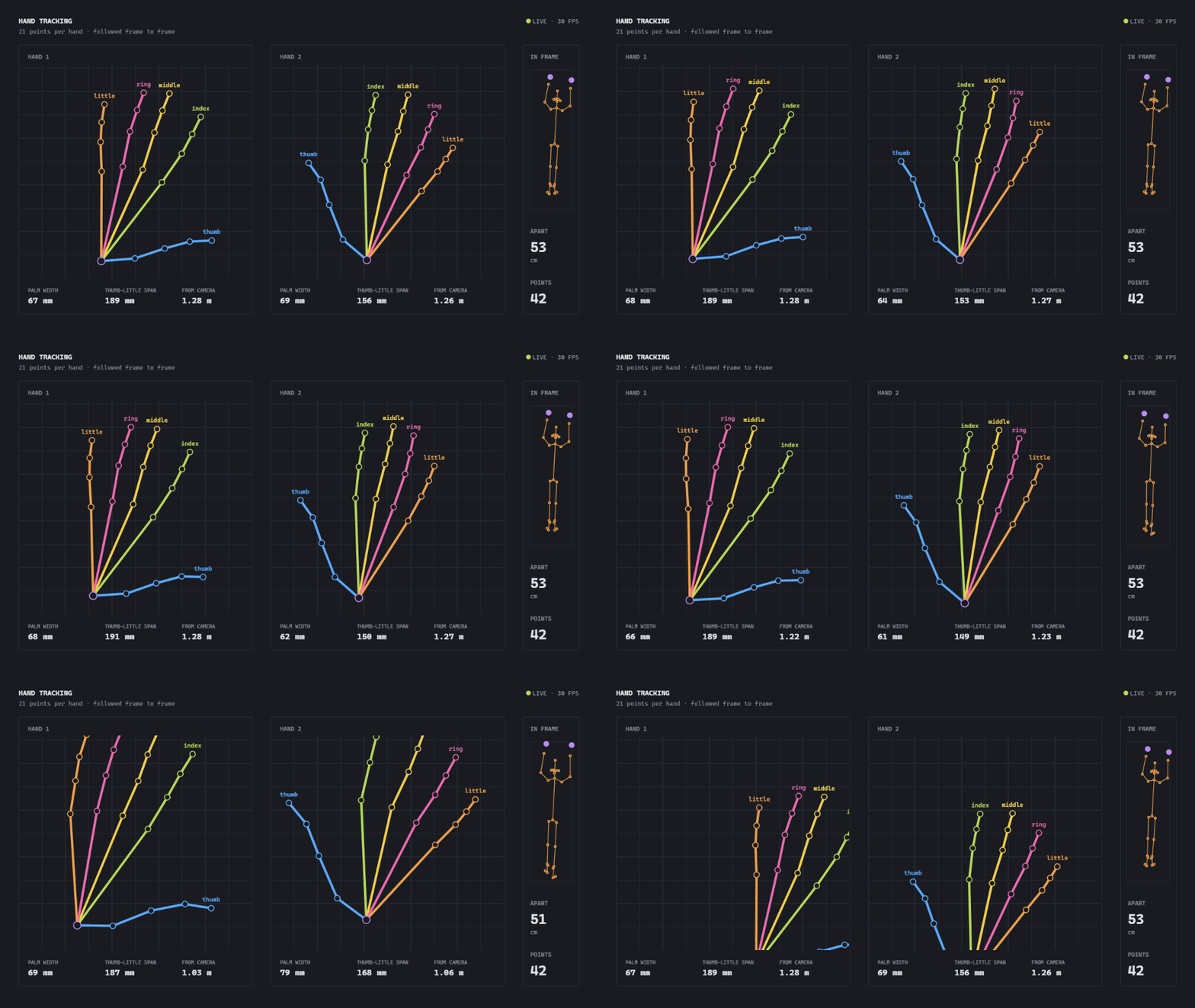
21 points per hand, every finger joint. A hand is followed from frame to frame once found, rather than searched for again in every picture.
Face detection per person, with the head's direction in degrees — turn, nod and tilt — and a simple expression read.
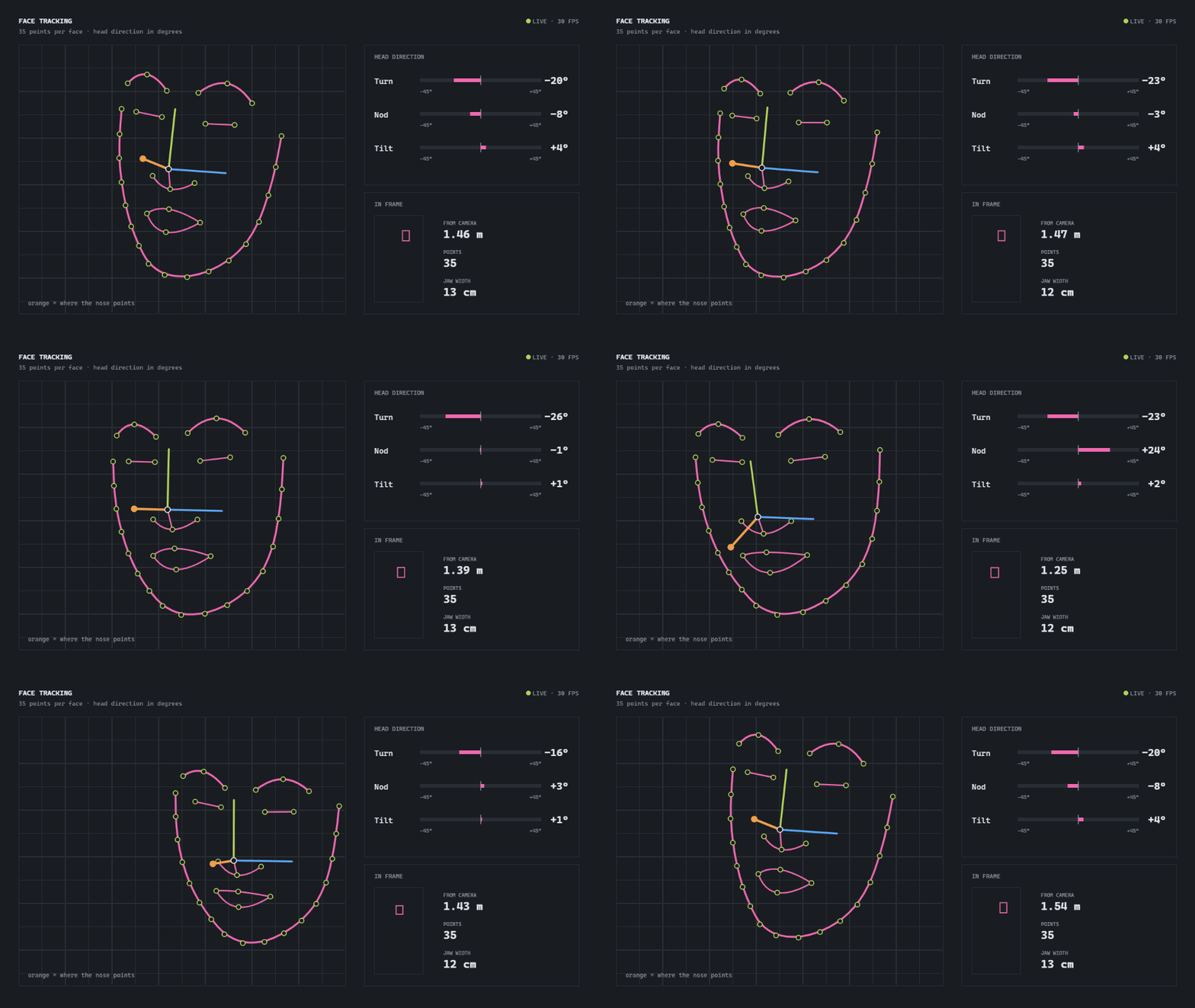
35 points per face — eyes, brows, nose, mouth and jaw line — each with a position in space.
Round fiducials for quick, cheap targets where a full ArUco tag is overkill.
In motion
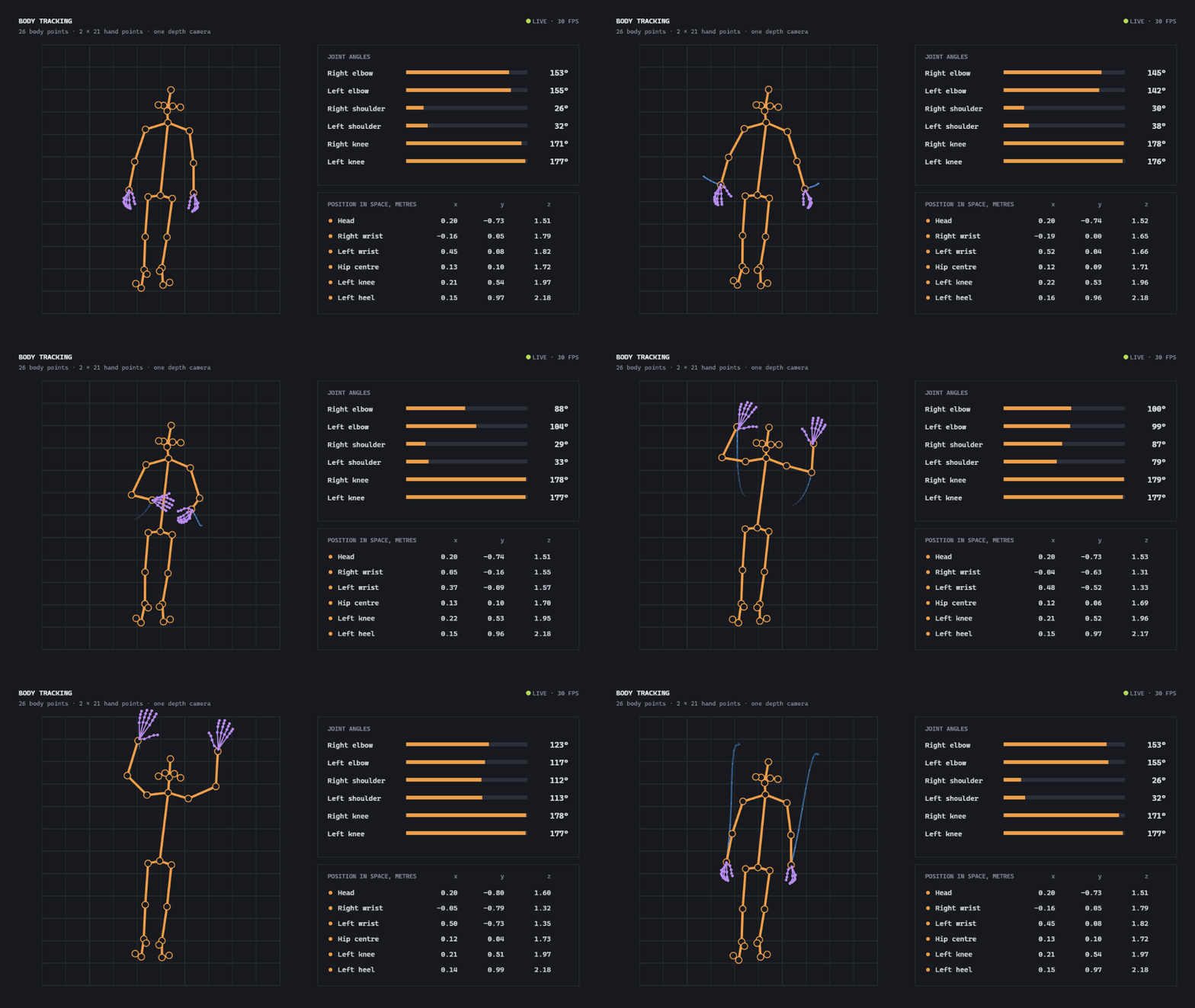
These plates are drawn from a real recording of the module's output — one person, one camera, nothing worn. The figure is the data: every dot is a point Track reported for that frame, and every line joins two of them. Nothing is drawn in that the module did not measure.

Body tracking — 26 body points with both hands attached. Joint angles and positions are computed from the stream as it arrives; the blue traces are the wrists' last second of travel.

Hand tracking — 21 points per hand, a colour per finger. Because the points are in real units, a palm width or a finger span is a measurement in millimetres, not a guess in pixels.

Face tracking — 35 points per face and the head's direction as three angles: turn, nod and tilt. An eye is its two corner points; the orange line is where the nose is pointing.
What the points become
Track does not decide what the movement means — it delivers named points in metres, frame after frame, and leaves the question to the application built on it. The figures in the plates above are examples of what a few lines of arithmetic on that stream give.
Inside the dashboard
The whole camera is controllable from the browser — no separate app, no config files.
Not just pixels
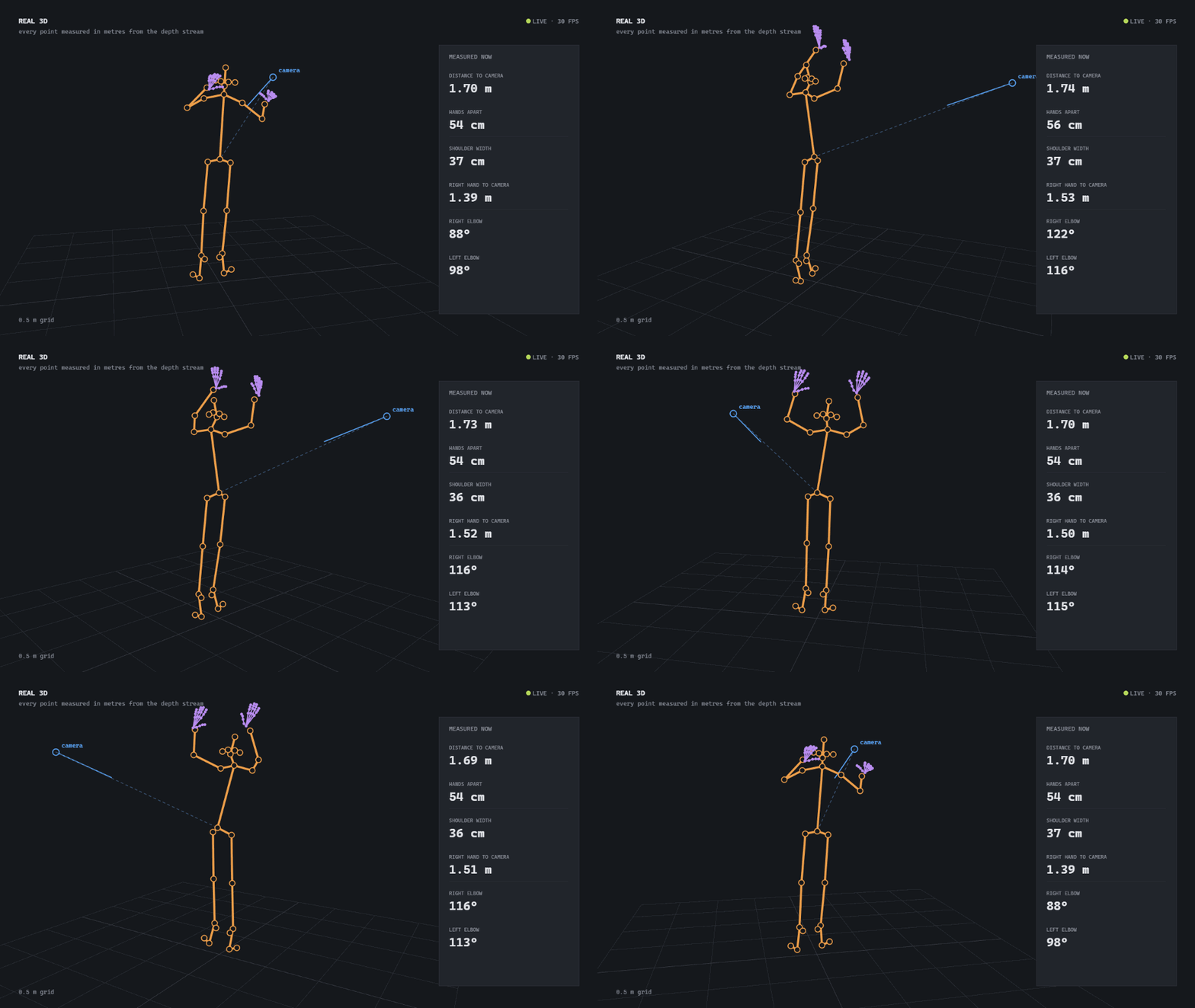
Because it's a depth camera, each marker and keypoint is deprojected into real-world coordinates — markers additionally get a full 6-DOF pose. Downstream tools get metres, not just pixels.

Real 3D — the same recording, turned in space. The view moves; the person does not flatten, because each point carries its own distance from the camera.
Building on it
The dashboard is one client among many. Everything it shows arrives over plain local connections that any program can open.
left_wrist, index_tip — and keep the same name whichever model produced them.Plainly stated
A single depth camera sees one side of a scene. Knowing where that stops is part of using it well.