IMU boards · pressure boards · chest straps · Bluetooth LE

Wireless orientation, pressure and heart signals, live in the browser.

BlinkPose.BLE.Stream connects over Bluetooth LE to a whole set of small wireless devices at once and republishes what each one measures in real time — IMU boards send a fused orientation quaternion, pressure boards send ten live load channels each, and a chest strap sends heart rate, beat-to-beat intervals and the raw ECG trace. Because the devices are small and wireless, it's the natural fit for wearables, props and mats — and you can tare any orientation board straight from the dashboard, capturing its current pose as a new zero reference on the fly.

orientation quaternion · 10 pressure channels · heart rate, RR and ECG · mixed rosters · real-time
localhost — BlinkPose.BLE.Stream
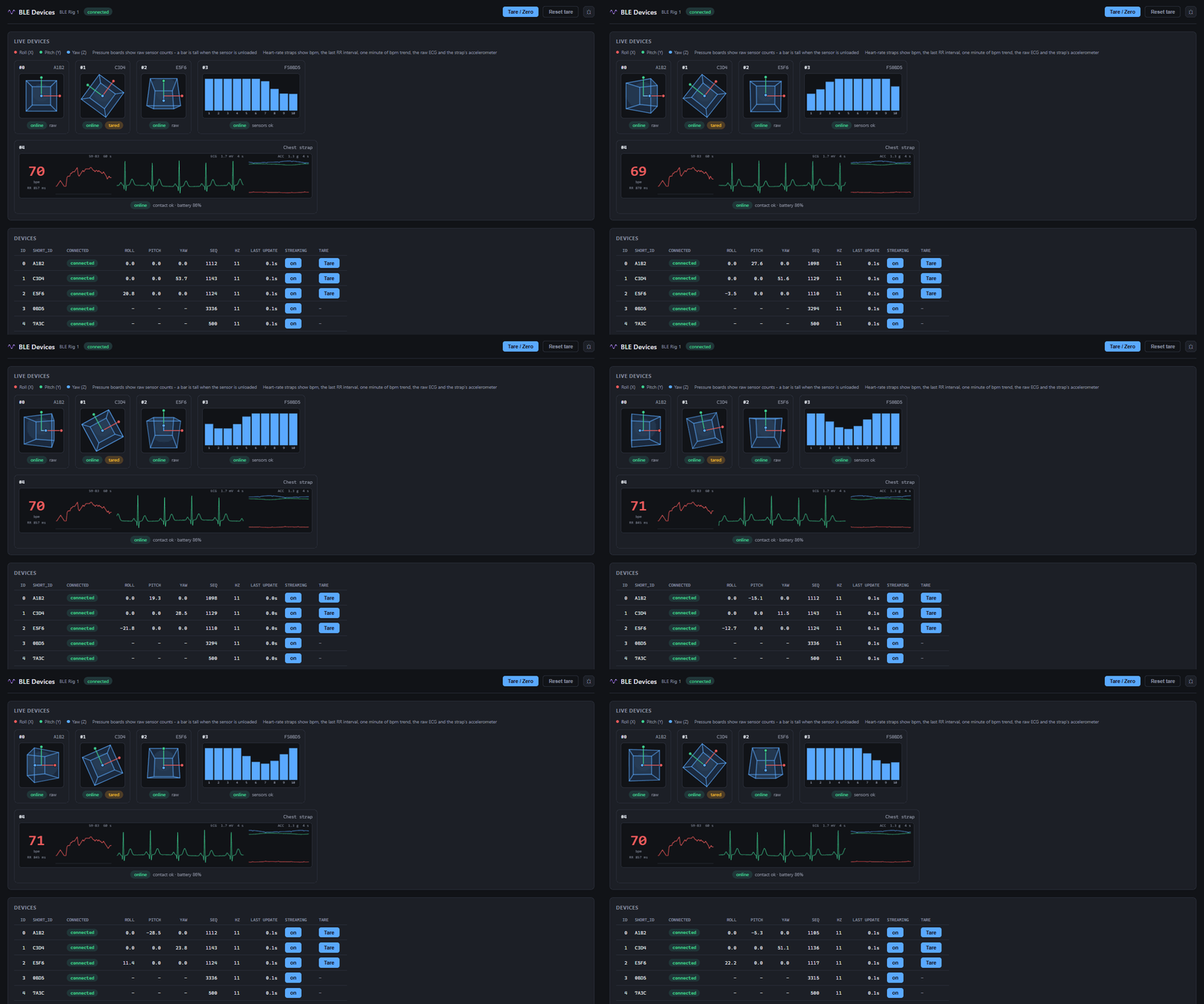
BlinkPose.BLE.Stream dashboard: live 3D orientation gizmos, pressure sensor bars, and a chest strap card with heart rate, ECG trace and accelerometer

BLE dashboard — every connected device on one page: orientation boards as tareable 3D gizmos, pressure boards as live sensor bars, and a chest strap as heart rate, trend, ECG trace and accelerometer.

What it streams

Three kinds of device, one link

Orientation boards, pressure boards and chest straps share every bit of the discovery, reconnect and network plumbing. They differ only in what they measure — and in the type that labels their entry in the JSON.

Fused orientation

Each IMU board's absolute orientation as a quaternion, sensor-fused on the device itself.

Ten pressure channels

Each pressure board reports ten load sensors, every one with its raw count, its voltage and a validity flag.

Heart rate, RR and ECG

A chest strap reports heart rate and every beat-to-beat interval, and a supported strap adds its raw ECG trace and accelerometer.

Mixed rosters

All three on the same instance and the same page, each entry tagged by its type — imu_orientation, pressure_sensors, heart_rate, ecg or accelerometer.

Per-device tare

Zero any orientation board to its current pose, live — capture a new reference on the fly.

Wireless & wearable

Small, battery-friendly BLE boards with no cables — ideal for props, wearables and mats.

The pressure board

Ten load channels, wireless

One small battery-powered board carrying up to three analog-to-digital converters, four plus four plus two, for ten pressure sensors. It scans them all at around 150 frames a second and notifies every second frame over BLE.

Raw counts and volts

Every channel arrives as both the raw converter count and the voltage it works out to, so you can calibrate against whichever you prefer.

Per-sensor validity

An unwired or unreadable channel is flagged invalid rather than sent as zero — "not reading" never gets mistaken for "reading nothing".

Board health in-band

Each packet carries the converter status mask, which modules answered, the board's own scan rate and its notify counters.

Hot-plug converters

The board finds its own I²C bus at boot and keeps re-probing, so a module reconnected mid-session comes back on its own.

Screen on the board

The built-in display shows link state, scan rate and a live bar per sensor — enough to tell a wiring fault from a link fault without a PC.

Names itself

Each board derives its own label from its BLE address, so one firmware image serves every board in the rig.

New — the chest strap

Heart signals next to movement

Add a Bluetooth chest strap to the same roster and its readings arrive in the same feed as the boards, on the same clock. Any strap that speaks the standard Bluetooth heart-rate service gives heart rate and RR intervals; a supported strap also streams its raw signals.

Heart rate, every second

Beats per minute as the strap computes it, with skin-contact and battery state alongside.

Every RR interval

Each beat-to-beat interval in milliseconds, delivered exactly once — the raw material for heart-rate variability.

Raw ECG at 130 Hz

The single-lead trace in microvolts, so you see each beat's shape and can tell a poor contact from a real change.

Strap accelerometer

Three axes at a rate you choose, 25 to 200 Hz — posture, breathing movement and a check on motion artefacts.

Time on your PC's clock

Every ECG and accelerometer frame carries the PC time of its last sample, so it lines up with everything else you record.

Gap detection built in

A running sample index on every frame shows at once whether anything was lost on the way.

The ECG here is a single lead from a chest strap, meant for rhythm, timing and variability work. It is not a diagnostic ECG.

Inside the dashboard

Every board, at a glance

All three families share one page: watch orientation, load and heart signals update in real time, and re-zero anything without leaving it.

Why it's different

The one that can go cable-free

Because it's Bluetooth LE, this is also the module a browser could talk to directly via Web Bluetooth — making it the natural pick for lightweight, install-light setups. Adding more kinds of device changed none of that: same JSON shape, same page, same look as every other module.

quat
fused orientation
10
pressure channels
130 Hz
raw ECG
BLE
wireless, wearable